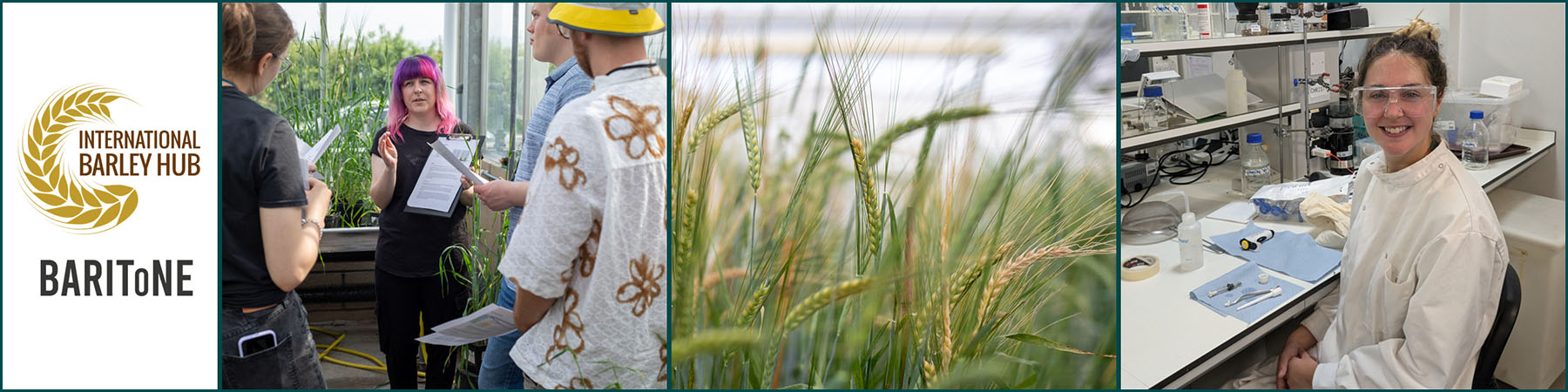
BARIToNE PhD Programme
BARIToNE
| Qualification Type: | PhD |
|---|---|
| Location: | Dundee |
| Funding for: | UK Students |
| Funding amount: | £20,780 Funding covers student fees and a monthly stipend, set at the standard UKRI rate (full time £20,780 in 2025/26) |
| Hours: | Full Time |
| Placed On: | 6th February 2026 |
|---|---|
| Closes: | 15th March 2026 |
The Barley industrial training network (BARIToNE) is BBSRC and industry-funded Collaborative Training Partnership (CTP, comprising 18 industrial and 7 academic collaborating partners. We are seeking to reduce environmental impacts across all sectors of the barley supply and value chain.
BARIToNE students are supported through a comprehensive training programme, fully engaged with industry, that develops highly skilled scientists with diverse expertise and knowledge across the full barley supply chain.
We have three 4-year PhD projects available for immediate entry. Projects are fully funded, providing an annual stipend at the UKRI rate (currently £20,780), tuition fees and costs to support the research project, individual projects are linked with an industry partner where you will have the opportunity to undertake a placement during your PhD. In this round, the opportunities are open to UK/Home students only.
Linking genes, protein structure, and traits in barley using AI-enabled modelling (Project code 25E)
Supervisors
- Lead supervisor - Dr Runxuan Zhang, James Hutton Institute
- Second supervisor - Dr Piers Hemsley, University of Dundee
- Industry supervisor - Dr Jenna Watts, Agriculture and Horticulture Development Board (AHDB)
Location
This project will be based at the James Hutton Institute, Invergowrie and the appointed student will register at University of Dundee as the degree awarding institution.
The project
Understanding how genetic variation leads to differences in crop traits such as yield and stress tolerance is a central challenge in modern biology and agriculture.
This PhD will combine computational modelling, AI-assisted protein structure analysis, and biological data integration to identify genes underlying important traits in barley. The project connects DNA sequence variation → protein structure → biological function → crop performance, using large-scale datasets and modern computational methods.
The project is co-developed with the Agriculture and Horticulture Development Board (AHDB), ensuring that the research questions, target traits, and data reflect real-world crop improvement priorities.
This is a computational / dry-lab PhD with strong biological grounding. The project is explicitly designed so that candidates from either a computational or biological background can succeed and grow into a genuinely interdisciplinary researcher.
What You Will Work On
- Analysing genomic, transcriptomic, and trait datasets from barley
- Exploring how genetic variation affects protein structure and function
- Using and adapting AI-based protein structure prediction tools (e.g. AlphaFold-style approaches)
- Integrating multiple data types (sequence, structure, expression, phenotype)
- Developing reproducible computational pipelines in Python (and/or R)
- Interpreting results collaboratively with biologists and industry partners
- Publishing research in computational biology and AI-enabled life science journals
This PhD is part of an academic–industry collaboration with AHDB, providing:
- An industry supervisor involved in shaping project direction
- Access to industry-relevant datasets and trait priorities
- Regular interaction with applied scientists working in crop improvement
- Insight into how computational and AI tools translate into practical breeding decisions
- Exposure to non-academic career pathways in agri-tech, biotech, and applied data science
Training and Support
The project includes:
- Structured training in computational biology and applied AI
- Close supervision from experts in biology, protein science, and data analysis
- Access to courses and workshops in machine learning, bioinformatics, and statistics
- Flexibility to adjust the project emphasis as your skills develop
Assessing the potential of Circularity in Integrated Systems for mitigating Greenhouse gas emissions and Net Zero in Barley supply chains (Project code 25J)
Supervisors
- Lead supervisor - Dr Jagadeesh Yeluripati, James Hutton Institute
- Additional supervisors - Professor Tim George and Dr Bhakskar Mitra, James Hutton Institute; Professor John Rowan, University of Dundee
- Industry supervisor - Victoria Buxton, Scotgrain Agriculture
Location
This project will be based at the James Hutton Institute, Aberdeen and the appointed student will register at University of Dundee as the degree awarding institution.
The project
The pursuit of achieving Net Zero emissions in agriculture is a significant challenge, especially considering the sector's substantial contribution to global greenhouse gas (GHG) emissions. This Ph.D. research aims to evaluate the potential of circularity within integrated crop-livestock-forestry systems as a strategy for mitigating GHG emissions, with a specific focus on barley production.
Integrated crop-livestock-forestry systems offer multiple opportunities to reduce the environmental impact of agricultural production systems. Circular systems have been proposed to increase resource use efficiency, particularly of scarce nutrients, in a more sustainable way than conventional systems. Therefore, bringing in circularity contributes to minimizing the environmental footprint of agriculture. We will develop a matrix of (existing) indicators for effective quantification of the status of circularity within various integrated system. Contrasting scenarios of carbon, nutrients, water, and biomass flows will be simulated in a diversity of case studies involving a range of intensity system through the application of process-based models such as manureDNDC. This analysis will return the predictions trajectories at farm level to redesign systems towards more complete local circularity within croplivestock-forestry integrated systems, delivering enhance environmental credentials, such as reduced scope 3 emissions to the system. The research aims to provide a comprehensive evaluation of the environmental benefits and practical feasibility of circular integrated systems. By doing so, it seeks to inform policy and practice, supporting the adoption of sustainable agricultural methods that align with global climate goals. The outcomes of this research will be pivotal in guiding the transition towards more sustainable, resilient, and climate-friendly barley production systems.
Data-Driven Crop Breeding for Climate-Resilient Barley (Project code 25L)
Supervisors
- Lead supervisor - Dr Paul Shaw, James Hutton Institute
- Additional supervisors - Sebastian Raubach, James Hutton Institute; Dr Hajk Drost, University of Dundee; Dr Miguel Sanchez Garcia, ICARDA, Morocco
- Industry supervisor - Dr Benjamin Kilian, Crop Trust
Location
This project will be based at the James Hutton Institute, Dundee and the appointed student will register at University of Dundee as the degree awarding institution.
The project
Modern crop breeding faces an immediate challenge: how to deliver resilient, high-yielding varieties fast enough to keep pace with climate change.
This PhD project combines crop genetics and data-driven decision making, with a strong emphasis on biologically grounded questions and practical relevance to breeding programmes.
You will work with real barley data to understand how genetic relationships, historical selection, and environmental context shape breeding outcomes. This understanding will then be used to determine which statistical and computational approaches can support a better decision making to find more adaptable crop varieties for a particular local field.
No prior experience in machine learning or artificial intelligence is required. The project is designed to build confidence step-by-step, starting from familiar data science and statistical approaches and gradually introducing more advanced modelling methods where appropriate.
You will:
- Analyse crop data from barley breeding programmes
- Use R and related data science tools to explore inheritance patterns, population structure, and trait prediction
- Learn how to develop interpretable statistical and computational models that link data to breeding outcomes
- Learn how predictive approaches (including ML-based methods) are used responsibly and transparently in applied crop science
- Collaborate with crop scientists and breeders to ensure results remain biologically meaningful and practically useful
Throughout the PhD, emphasis is placed on understanding the biology first, with computational tools used to answer well-defined scientific questions.
Training and support
This project offers structured, supportive training, including:
- Core supervision from experts in crop genetics, quantitative biology, data analysis, and AI
- Gradual introduction to machine learning concepts, tailored to your background and pace
- Opportunities to attend methods workshops, summer schools, and conferences
- A collaborative supervisory environment where questions are encouraged and expectations are made explicit
You will not be expected to "already know everything". The goal is to grow expertise over time, not to test prior knowledge.
Our research community thrives on the diversity of students and staff which helps to make the University of Dundee a UK university of choice for postgraduate research. We welcome applications from all talented individuals and are committed to widening access to those who have the ability and potential to benefit from higher education.
Visit the link to apply now!
Closing Date: 15/03/202
Share on social media



Advert information
Type / Role:
Subject Area(s):
Location(s):
PhD tools
PhD Alert Created
Job Alert Created
Your PhD alert has been successfully created for this search.
Your job alert has been successfully created for this search.
Ok OkPhD Alert Created
Job Alert Created
Your PhD alert has been successfully created for this search.
Your job alert has been successfully created for this search.
Manage your job alerts Manage your job alertsAccount Verification Missing
In order to create multiple job alerts, you must first verify your email address to complete your account creation
Request verification email Request verification emailjobs.ac.uk Account Required
In order to create multiple alerts, you must create a jobs.ac.uk jobseeker account
Create Account Create AccountAlert Creation Failed
Unfortunately, your account is currently blocked. Please login to unblock your account.
Email Address Blocked
We received a delivery failure message when attempting to send you an email and therefore your email address has been blocked. You will not receive job alerts until your email address is unblocked. To do so, please choose from one of the two options below.
Max Alerts Reached
A maximum of 5 Job Alerts can be created against your account. Please remove an existing alert in order to create this new Job Alert
Manage your job alerts Manage your job alertsCreate PhD Alert
Create Job Alert
When you create this PhD alert we will email you a selection of PhDs matching your criteria.When you create this job alert we will email you a selection of jobs matching your criteria. Our Terms and Conditions and Privacy Policy apply to this service. Any personal data you provide in setting up this alert is processed in accordance with our Privacy Notice
Create PhD Alert
Create Job Alert
When you create this PhD alert we will email you a selection of PhDs matching your criteria.When you create this job alert we will email you a selection of jobs matching your criteria. Our Terms and Conditions and Privacy Policy apply to this service. Any personal data you provide in setting up this alert is processed in accordance with our Privacy Notice
Max Saved Jobs Reached
A maximum of 500 Saved Jobs can be created against your account. Please remove an existing Saved Job in order to add a new Saved Job.
Manage Saved JobsMore PhDs like this
PhD Studentship: Enhancing AI medical applications on AMD cutting-edge AI hardware
PhD Studentship: Protecting privacy while preventing wandering in people living with mild dementia
PhD Studentship: The Neonatal Virtual Brain - VISI-ON-BRAIN MSCA Doctoral Network
Join in and follow us





