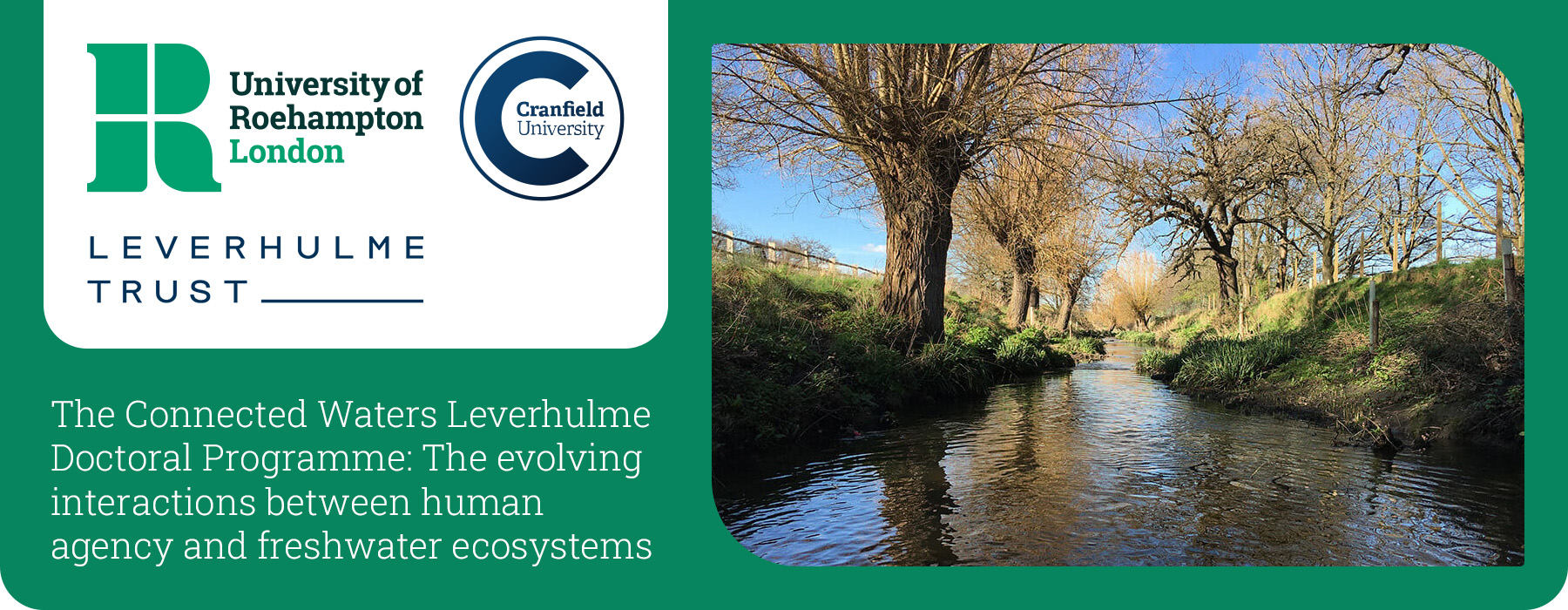
Funded Masters and PhD Scholarships through the Connected Waters Leverhulme Doctoral Programme
A partnership between Roehampton University and Cranfield University, funded by the Leverhulme Trust
(a partnership between Roehampton University and Cranfield University, funded by the Leverhulme Trust).
Rivers are now among the most threatened ecological systems and their degradation is caused by human activities which are underpinned by human values and societal priorities. However, as freshwater ecosystems change, how humans perceive, value, and ultimately manage them also changes. Understanding past, present and future connections within freshwater environments and between them and human society through an interdisciplinary lens is vital to restoring our relationship with them for the benefit of future generations.
This Leverhulme doctoral programme will train a new generation of interdisciplinary scholars to develop a deeper, holistic view of the interactions between humans and freshwaters, laying the groundwork for solutions that work for people and nature.
In total the award will fund up to 18 full time PhD Scholarships, in three cohorts over three successive years. We are now recruiting the third cohort.
Each PhD scholarship award will include fees and stipend costs for scholars for up to 4 years paid at UKRI's standard domestic rate, with an additional grant of up to £10,000 for each student for research expenses.
One Master's plus PhD scholarship is also available for students from underrepresented groups. Here there is funding (fees and stipend) for an additional 1 year Master's programme before the PhD programme commences.
For entry in October 2026 we are offering up to four projects at Roehampton University (3 PhDs and 1 Masters plus PhD) and more at Cranfield University (see here). For further project details, eligibility requirements and how to apply see the Connected Waters Leverhulme Doctoral Programme website- here:
For Roehampton projects, once contact has been made with the relevant academic supervisor and you have been encouraged to apply, please do so via the Graduate School application portal here, remember to attach the completed Connect cover form (from the Connecting Waters webpage), your personal statement and your research proposal to your completed online application form.
Please contact pgresearch@roehampton.ac.uk if you require further advice on the application process.
Funded projects registered at Roehampton University (deadline 31/03/2026). Please contact the named supervisor below for further details.
Sacred waters: faith and folk traditions and their role in conservation and management of natural water sources. PhD project
Supervisors: Nick Mayhew Smith & Ashley Cocksworth
Natural water has attracted veneration, worship and a wide range of ritual activities for millennia, cultic practices even surviving transitions between different religions and changes in dominant cultures. This programme of research will examine some of the very long narratives that have developed around sacred water courses in a mostly British context, including springs, wells, lakes, rivers and the sea, examining their lingering cultural footprint in the 21st century. It will focus on the extent to which popular imagination and memory can help efforts to conserve and restore these natural phenomena. Ritual activities and communal attachments include bathing traditions, the presumed health-giving properties of natural water sources, legends of aquatic creatures and spirits, and water as a place of healing and rebirth. The researcher will select a range of springs, ponds and other natural bodies of water and examine both their long history of devotional use and their ongoing significance to their local community today. This will involve historical research, including local history archives, which will be set alongside field studies of the cultic and ritual practices that have developed and continue into the present time, including site survey, observation and interviews with devotees and more casual site visitors. The project takes an innovative approach in placing traditional cultic rituals and folk attachment to sacred sites in dialogue with modern perceptions and practices that continue to cluster around natural water sources and bodies. Discerning some of these long narratives that connect people to place will ultimately shed new light on the enduring influence spiritual concern can have on efforts to conserve and value natural heritage.
The Great Outdoors: Does exposing our senses to natural water sources benefit our physiology and psychology? PhD project
Supervisors: Lewis Halsey & Lauren Stewart
Exposure to natural environments is known to boost human health. But little is understood about exactly what environments are beneficial, for whom and under what circumstances. We need a better understanding of the mechanisms linking environmental attributes to positive mental and physical health outcomes for humans, and this can be achieved with robust field experiments. Bodies of water, perhaps particularly running water such as rivers, are considered to be restorative in a number of ways, and this might be explained by an evolved attraction to fresh water sources. This PhD project will involve isolating and exposing individual senses to natural water-based environments of different types e.g. upland vs lowland rivers, while measuring physiological and psychological parameters previously shown to respond positively to whole-body, real-world, nature immersion. The findings will advance understanding of how exposure to rivers positively influences human biology, and in turn what realistic interventions might be helpful to individuals with limited access to nature.
Tracking Antimicrobial resistance evolution and dissemination in human-impacted waterways Masters plus PhD project
Supervisors: Tivkaa Amande & Anne Robertson
Antimicrobial resistance (AMR) is an urgent global health challenge responsible for 1.27 million deaths in 2019. Sewage pollution, clinical effluents, and industrial activities account for the spread of antimicrobial-resistant microorganisms and antimicrobial resistance genes (ARGs) in natural waterways. These freshwater ecosystems serve as reservoirs and hotspots for horizontal gene transfer, creating opportunities for the evolution of novel resistance determinants. This project aims to understand how AMR evolves, persists, and disperses in freshwater environments.
The PhD researcher will study the temporal and spatial variation of ARG in urban and rural waterways using culture-dependent, culture-independent molecular biology and bioinformatic approaches to detect/quantify ARGs and mobile genetic elements in waterways. High-throughput sequencing approaches such as metagenomic sequencing will be used to study the microbial community structure, resistome diversity, and potential gene transfer events. The project will help us to understand how changing human activities shape AMR evolution in waterways and will contribute to environmental policy, improved monitoring frameworks, and strategies aimed at mitigating the spread of AMR through freshwater ecosystems.
Aquatic parasites as indicators of ecosystem function. PhD project
Supervisors: Cecile Reed & Anne Robertson
It is widely understood that changes in aquatic parasite community dynamics, such as declines in diversity or increases in host infection rates, can signal the influence of local environmental stressors such as pollution or habitat degradation. Less is known about the responses of aquatic parasite communities to improving ecological conditions, for example through habitat restoration or reductions in pollutants, despite the acceptance that healthy ecosystems should have healthy parasite communities. River restoration aims to improve river health and function and ecological recovery in such projects is currently measured primarily using macroinvertebrates and fish community indices. An opportunity thus exists to deepen our understanding of ecological recovery by studying the responses of aquatic parasite communities to river restoration efforts.
| Qualification Type: | PhD |
|---|---|
| Location: | London |
| Funding for: | UK Students |
| Funding amount: | £10,000 |
| Hours: | Full Time |
| Placed On: | 9th December 2025 |
| Closes: | 31st March 2026 |
Share on social media



Show all PhDs for University of Roehampton …
Advert information
Type / Role:
Subject Area(s):
Location(s):
PhD tools
PhD Alert Created
Job Alert Created
Your PhD alert has been successfully created for this search.
Your job alert has been successfully created for this search.
Ok OkPhD Alert Created
Job Alert Created
Your PhD alert has been successfully created for this search.
Your job alert has been successfully created for this search.
Manage your job alerts Manage your job alertsAccount Verification Missing
In order to create multiple job alerts, you must first verify your email address to complete your account creation
Request verification email Request verification emailjobs.ac.uk Account Required
In order to create multiple alerts, you must create a jobs.ac.uk jobseeker account
Create Account Create AccountAlert Creation Failed
Unfortunately, your account is currently blocked. Please login to unblock your account.
Email Address Blocked
We received a delivery failure message when attempting to send you an email and therefore your email address has been blocked. You will not receive job alerts until your email address is unblocked. To do so, please choose from one of the two options below.
Max Alerts Reached
A maximum of 5 Job Alerts can be created against your account. Please remove an existing alert in order to create this new Job Alert
Manage your job alerts Manage your job alertsCreate PhD Alert
Create Job Alert
When you create this PhD alert we will email you a selection of PhDs matching your criteria.When you create this job alert we will email you a selection of jobs matching your criteria. Our Terms and Conditions and Privacy Policy apply to this service. Any personal data you provide in setting up this alert is processed in accordance with our Privacy Notice
Create PhD Alert
Create Job Alert
When you create this PhD alert we will email you a selection of PhDs matching your criteria.When you create this job alert we will email you a selection of jobs matching your criteria. Our Terms and Conditions and Privacy Policy apply to this service. Any personal data you provide in setting up this alert is processed in accordance with our Privacy Notice
Max Saved Jobs Reached
A maximum of 500 Saved Jobs can be created against your account. Please remove an existing Saved Job in order to add a new Saved Job.
Manage Saved Jobs


