Doctoral Researcher (M/F/D)
Max Planck Institute for Political and Social Science – Department of Political Institutions and Conflict
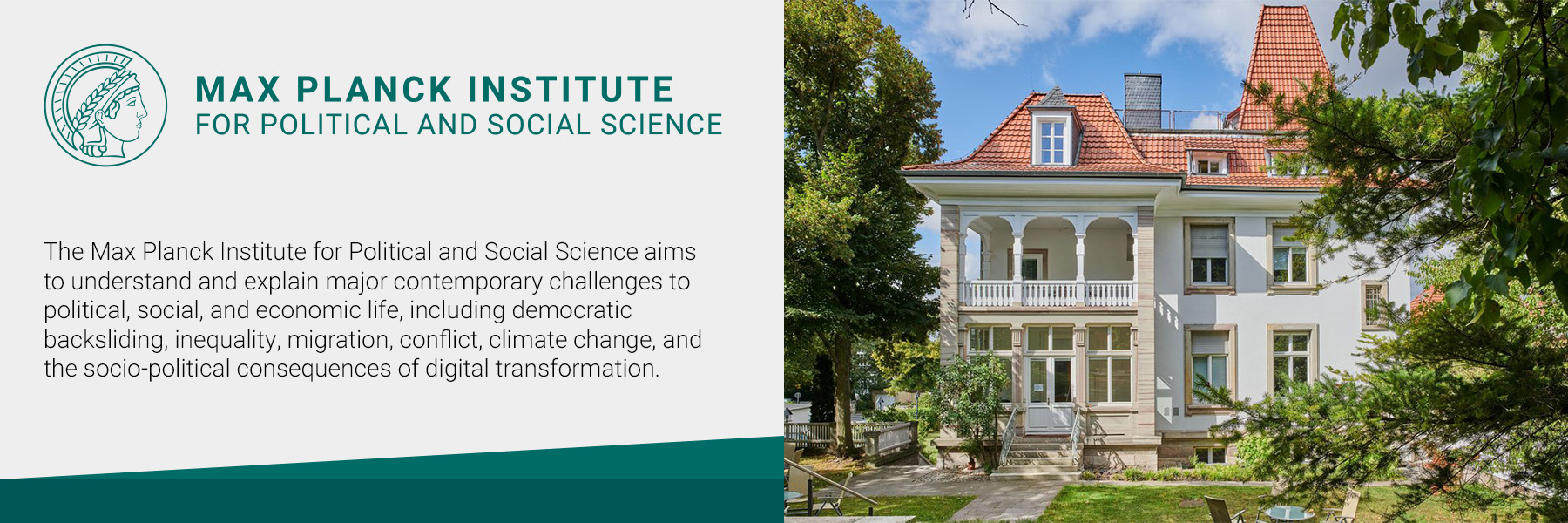
The newly founded Max Planck Institute for Political and Social Science studies contemporary challenges to political, social, and economic life. The institute places special emphasis on the political dimension, thereby spanning the spectrum from political sociology through conflict and peace research to political economy. Rigor and imagination guide the institute’s analytical and empirical approach, which draws inspiration from cross-disciplinary developments. The institute aims to produce new, evidence-based insights for pressing challenges to policy and contemporary society.
At the Institute, the Department of Political Institutions and Conflict is inviting applications for the position of
Doctoral Researcher (M/F/D)
(full-time for three years with a starting date of January 1, 2027).
The newly established department “Political Institutions and Conflict” (led by Ursula Daxecker) studies the relationship between political institutions and conflict, broadly construed. Conflict is inherent in politics but can be managed peacefully or break out in the open and turn violent. Research in the department explores whether and how political, economic, and social institutions create or reduce the potential for conflict, how structural changes have changed institutions’ ability to manage conflict, and how these shifts affect political outcomes downstream. Through this research, the department aims to produce novel insights for important challenges in contemporary society, including the rise of extreme strategies and violence, threats to electoral integrity, and democratic erosion.
The PhD candidate will be affiliated with the “Doctoral Network Democratic Institutions and Violence Network in Europe (DIViNE)” project, funded by the HORIZON MSCA action. The candidate will be supervised by Dr. Ursula Daxecker. DIViNE brings together leading European research environments — UvA (Amsterdam), UESSEX (Essex), UMIL (Milan), UC3M (Carlos III de Madrid) and UU (Uppsala) — and partner organizations – including the new Max Planck Institute for Political and Social Science — to combine complementary strengths in quantitative conflict research, behavioral and experimental methods, historical and archival inquiry, institutional and normative theory, and applied policy engagement.
Responsibilities (what you will do):
Democracies are commonly seen as able to channel contestation through institutionalized processes and nonviolent action. Yet, democratic politics frequently experience a broad range of political violence — from riots and organized electoral intimidation to extremist mobilization and criminal violence — and violence can test and, at times, erode democratic norms and institutions. Moreover, democracies themselves may respond to perceived threats with measures (e.g., militarized policing, emergency legislation, selective repression) that threaten to undermine core features of liberal democracy such as the rule of law, civil liberties and institutional impartiality. The DIViNE Doctoral Network (Democratic Institutions and Violence Network in Europe) consolidates comparative, historical, theoretical and methodological strands to build a coherent new research program on political violence in democracies.
The position is part of WP3 on Dynamics of Support for Violent Movements and Responses, which focuses on the micro-foundations of public support for, and tolerance of, political violence, including how violent organizations cultivate legitimacy. The PhD project aims to explain variation in violent strategies across time and space, distinguishing between violent rhetorical and behavioral strategies. The project is also interested in understanding the relationship between rhetoric and behavior, and how both strategies shape outcomes downstream. Empirically, the project examines political violence in the Global North, aiming to conduct subnational, constituency-level analyses of violent strategies in Global North cases. The methodological approach makes uses of innovations to study sensitive topics and difficult-to-reach populations, such as shadowing, fieldwork, special survey techniques, and use of multimodal data. The project will generate policy-relevant knowledge on patterns of radicalization, public tolerance for violence, and the vulnerabilities of established democracies.
The doctoral trajectory includes a secondment at the University of Amsterdam and Clingendael in the Netherlands, which will provide the PhD candidate with additional training and exposure to policy engagement and strategic communication on extremist threats.
Specifically, you will:
- Produce a doctoral thesis that will be defended at the University of Amsterdam’s Faculty of Social Sciences, with the goal of obtaining the degree of PhD.
- Conduct PhD research on the dynamics of support for violent movements and responses, including quantitative analysis of data, surveys and survey experiments, and fieldwork interviews.
- Co-author publications with other project members;
- Carry out fieldwork and interviews in research locations;
- Assist with administrative responsibilities related to the project, such as the organization of workshops, conferences, or other project events.
- Take active part in DIViNE training network activities including network training modules, PhD colloquia, research workshops, secondments, and training workshops;
- Be affiliated with and take active part in the research environment at the department and institute. Regular physical presence at the Institute is therefore required and researchers need to reside within commuting distance of Göttingen. We will assist with finding adequate housing and with applying for visas and residence permits.
Requirements:
You have the following credentials:
Essential:
- A Master’s degree or equivalent in political science or closely related discipline. The degree must have been obtained by the start of your employment;
- An excellent command of social science research methods, including quantitative methodology such as panel regression, analysis of large administrative data, survey data, large language models and AI, causal inference design, and statistical programming in Stata/R/etc.;
- Excellent oral and written communication skills in English;
- Independent thinking and critical analytical skills;
- The ability to work independently and in a team.
Desirable:
- Experience with qualitative methods and mixed-methods approaches;
- Interest and willingness to conduct fieldwork;
- Expertise in research on political violence.
What We Offer:
The position is full-time and for a period of three years (with the option of up to two extensions of six months each). Salary is based on the German collective agreement for civil servants (TVöD Bund), pay group EG 13, 75%/grade 1 – 2.
The Max Planck Society is mainly funded by German Federal and State Governments (see www.mpg.de). Max Planck Institutes provide outstanding facilities, academic resources and intellectual environments for the support of independent research. Max Planck Institutes are not tied to universities. There are no teaching obligations for staff, but teaching and other forms of co-operation with universities are possible.
The Max Planck Society wishes to increase the participation of women across the sciences. Applications from women are therefore particularly welcome. Following its commitment to equal opportunities employment policies, the Max Planck Society especially encourages applications from persons with a disability. Persons of any nationality can apply.
Applications must be submitted online no later than Wednesday, November 11, 2026. Applications must consist of:
- A CV
- A two-page cover letter that outlines your preparation and motivation to pursue this degree
- A two-page proposal outlining a PhD project that fits the above parameters
- Unofficial undergraduate and graduate transcripts
- The contact details of two academic references
- A writing sample of max. 10 pages (this can be an excerpt from longer written material).
The deadline for applications is November 11, 2026. Additional materials such as recommendation letters will be requested only for shortlisted candidates. The selection committee expects interviews to take place in Göttingen in the week of November 23. We ask you to ensure availability this week.
Queries should be directed to silvia.stoermer@ips.mpg.de. The Institute has been newly reestablished in 2026.
Max Planck Institute for Political and Social Science
Hermann-Föge-Weg 11
37073 Göttingen
For information on the institute, please consult ips.mpg.de.
| Qualification Type: | PhD |
|---|---|
| Location: | Göttingen - Germany |
| Funding for: | UK Students, EU Students, International Students |
| Funding amount: | Pay group EG 13, 75%/grade 1 – 2 |
| Hours: | Full Time |
| Placed On: | 8th October 2026 |
| Closes: | 11th November 2026 |
Share on social media



Show all PhDs for Max Planck Institute for Political and Social Science …
Advert information
Type / Role:
Subject Area(s):
Location(s):
PhD tools
PhD Alert Created
Job Alert Created
Your PhD alert has been successfully created for this search.
Your job alert has been successfully created for this search.
Ok OkPhD Alert Created
Job Alert Created
Your PhD alert has been successfully created for this search.
Your job alert has been successfully created for this search.
Manage your job alerts Manage your job alertsAccount Verification Missing
In order to create multiple job alerts, you must first verify your email address to complete your account creation
Request verification email Request verification emailjobs.ac.uk Account Required
In order to create multiple alerts, you must create a jobs.ac.uk jobseeker account
Create Account Create AccountAlert Creation Failed
Unfortunately, your account is currently blocked. Please login to unblock your account.
Email Address Blocked
We received a delivery failure message when attempting to send you an email and therefore your email address has been blocked. You will not receive job alerts until your email address is unblocked. To do so, please choose from one of the two options below.
Max Alerts Reached
A maximum of 5 Job Alerts can be created against your account. Please remove an existing alert in order to create this new Job Alert
Manage your job alerts Manage your job alertsCreate PhD Alert
Create Job Alert
When you create this PhD alert we will email you a selection of PhDs matching your criteria.When you create this job alert we will email you a selection of jobs matching your criteria. Our Terms and Conditions and Privacy Policy apply to this service. Any personal data you provide in setting up this alert is processed in accordance with our Privacy Notice
Create PhD Alert
Create Job Alert
When you create this PhD alert we will email you a selection of PhDs matching your criteria.When you create this job alert we will email you a selection of jobs matching your criteria. Our Terms and Conditions and Privacy Policy apply to this service. Any personal data you provide in setting up this alert is processed in accordance with our Privacy Notice
Max Saved Jobs Reached
A maximum of 500 Saved Jobs can be created against your account. Please remove an existing Saved Job in order to add a new Saved Job.
Manage Saved Jobs